
When Should you Peak?
Why it Matters When You Achieve, not just What you Achieve.


When I was in my 30s, I became convinced that the best time to peak was in your mid-late fifties. Bryan Cranston, during the Breaking Bad era, was the inspiration. Up to that point, I knew Cranston as a character actor on sitcoms. He was Watley on Seinfeld, and the dad on Malcolm in the Middle. He was known and recognized, but not universally acclaimed to be one of the greats of his generation. Then came Breaking Bad, Oscar-nominated films, Emmys, Tonys, Screen Actor Guild awards, all in his mid to late 50s. Now he’s widely accepted to be a generational talent, and an all around great human being. ChatGPT was kind enough to graph Cranston’s career arc, making some guesses about the tail end because Cranston is not that old (sorry Bryan, I wouldn’t have drawn the downward slope!).
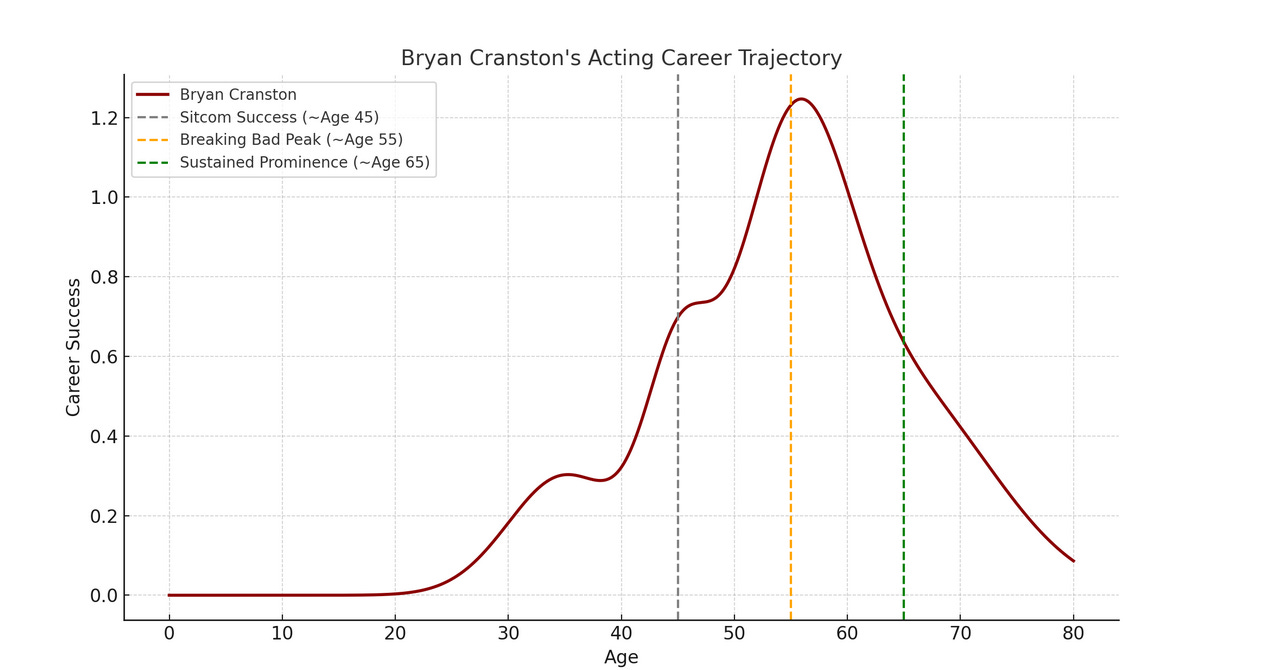
At the time, I took Cranston’s career arc to be normative; it was something to strive for. The best time to peak was in your mid to late fifties. The other person I remember admiring a lot was Marc Maron, whose earlier career and life failures were a theme in the early days of WTF, a podcast which ended up driving his career renaissance in his mid to late 50s. Recently, Maron, now in his early 60s, announced the end of the show, capping a peak that came with many comedy specials, a few television series, film roles, books, and critical acclaim for his interviewing prowess.
As soon as I was convinced that the best time to peak was in the mid fifties, I started structuring my life to achieve it. It is an ongoing project, and we’ll see in about a decade if it pays off. It is a gamble because there are two ways I can fail. The 20-year-plan might not pay off. To state the obvious, “succeeding” is a success term; it is possible to take all the steps and still fail; the world still need to cooperate. But the other way to fail is that I am wrong about the best time to peak. Maybe I reach my mid 50s and realize it was far better to have peaked in my 30s, or wait until my 70s. There wasn’t any rigor to my thinking. I just found people I identified with who were peaking and wanted to peak at the same time they did. Not everything you believe and act upon has to survive philosophical scrutiny. But now that I am halfway through the project, maybe it is time to build an argument. Maybe it will keep me motivated for the next 10 years.
Principle 1: If you peak in middle or high school, you’ve lost.
I think most people will accept this as axiomatic. But there is also empirical evidence. The coolest kids in adolescence turn out to be losers by their 20s. It makes sense; think of what it means to peak at 14; it probably means you smoke cigarettes, have sex, drink alcohol, and act like an adult amongst a group of insecure children, all acts we at middle-age recognize to be reckless and destructive behavior. But even if you aren’t a juvenile delinquent, but rather the star receiver who scores four touchdowns in a single game and insist the world recognize it for years afterward, you still don’t want adolescence to be your highest point. Peak too young and the rest of your life is in the shadow of your youth.
Principle 2: If you peak in your 80s, you’re going to die at your peak, which is a tragedy.
Peak too old and you’ve lived most of your life aspiring without reaching. Peaking at the end of life makes for a redemptive life, but if I had to pick, I’d want a period of life when one is not striving, but reflecting, enjoying success and making sense of it rather than trying to top it. In recent years, I’ve also developed a healthy dose of bitterness about the choice of many octogenarians in American life not to step aside but rather continue to ride their wave of power for a third or fourth act. I’m not going to name names, but suffice it to say the younger among us attribute some rather awful consequences when already successful people refuse to slide down from their peak in old age. Peaking old may seem like something to strive for when you’re living inside your timeline. Who wants to think that their best days are behind them? But outside of the time line, it looks more like a curse, and a way to impose yourself on younger generations in an attempt to cheat mortality.
Take these general principles together and it follows that some time in mid-life is the ideal time to peak. But I don’t think its in your 40s, because other research suggests that that’s the time in which people are most unhappy. Peaking is not the same as being most happy. To the contrary, happiness and peaking have a loose and sometimes antagonistic relationship. Just ask 90s techno artist Moby, who told Jonathan Goldstein on one of the first episodes of Heavyweight,
“Literally the most depressed I've ever been in my entire life was the height of my professional success.”
This is not unusual for people who peak in their earlier adulthood. Peaking means the height of accomplishment. The ideal time to peak should be a time when you’ll be happy and content with your peak, not a time when peaking comes with misery, insecurity, and a constant dissatisfaction associated with wanting more. There are very good reasons not to want to peak in your 20s and 30s; there’s too much life ahead of you, too much competition with yourself. Later life peaks are likelier to be earned, not gifted. As a result, they are likelier to be experienced with maturity and perspective rather than the chaos that plagues young peakers; phenoms, prodigies, the precocious, the beautiful. I’ve seen too many young peakers drown in their own early greatness, unsure whether their success was earned or gifted. There was the tennis player Donald Young who was the youngest ever #1 junior and the future of American tennis, but who retired last year after a completely unremarkable career. And of course, there are many 80s actors like Corey Feldman. Molly Ringwald, and MacCauley Culkin, and even academic peers who were stars out of graduate school but faded since. People who peak older seem to experience success with wisdom, and Socrates was right in his speech to Athens more than two thousand years ago. Wisdom, not wealth, fame, and acclaim, is what makes success good.
The case against the 40s, 30s, and 20s makes late midlife seems like the sweet spot for peaking. Ergo, the ideal time to peak is the mid to late fifties.
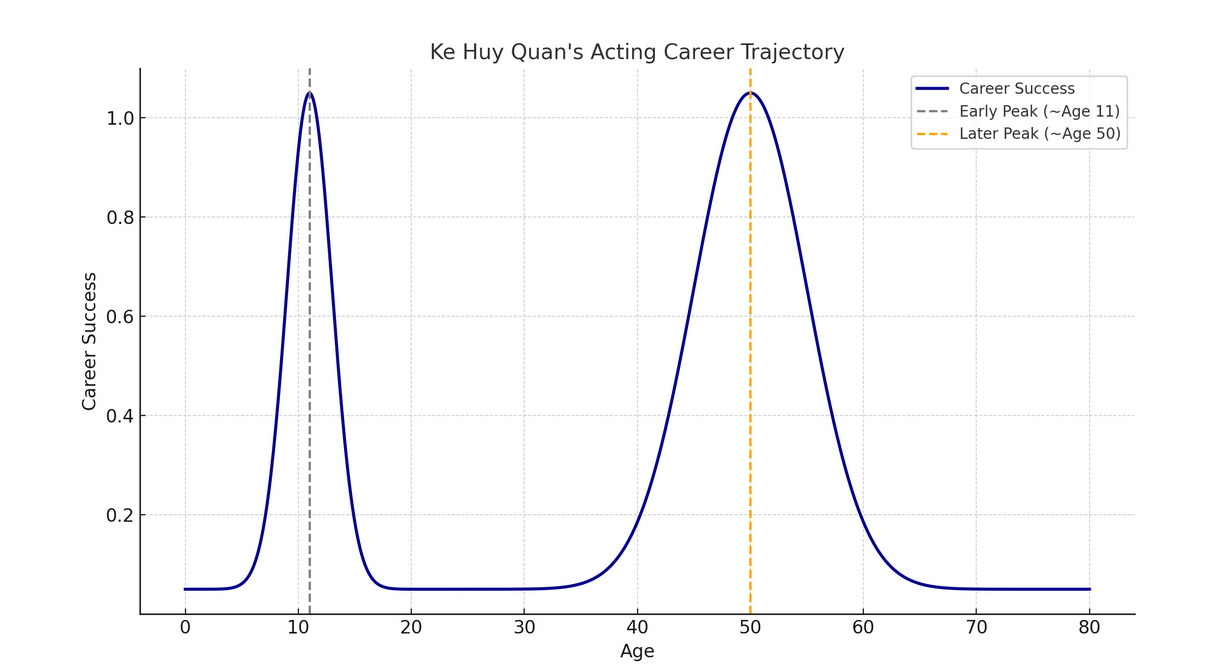
Some careers have multiple peaks. Ke Huy Quan has had quite the renaissance after being one of the most recognizable child actors of the 80s. Without such a revival, Quan would have peaked at age 10. Given that particular peak, it wasn’t a tragedy, but it is not something any of us want for ourselves or our children. But instead, Quan second peak has become the Hollywood comeback story of the 2020s.
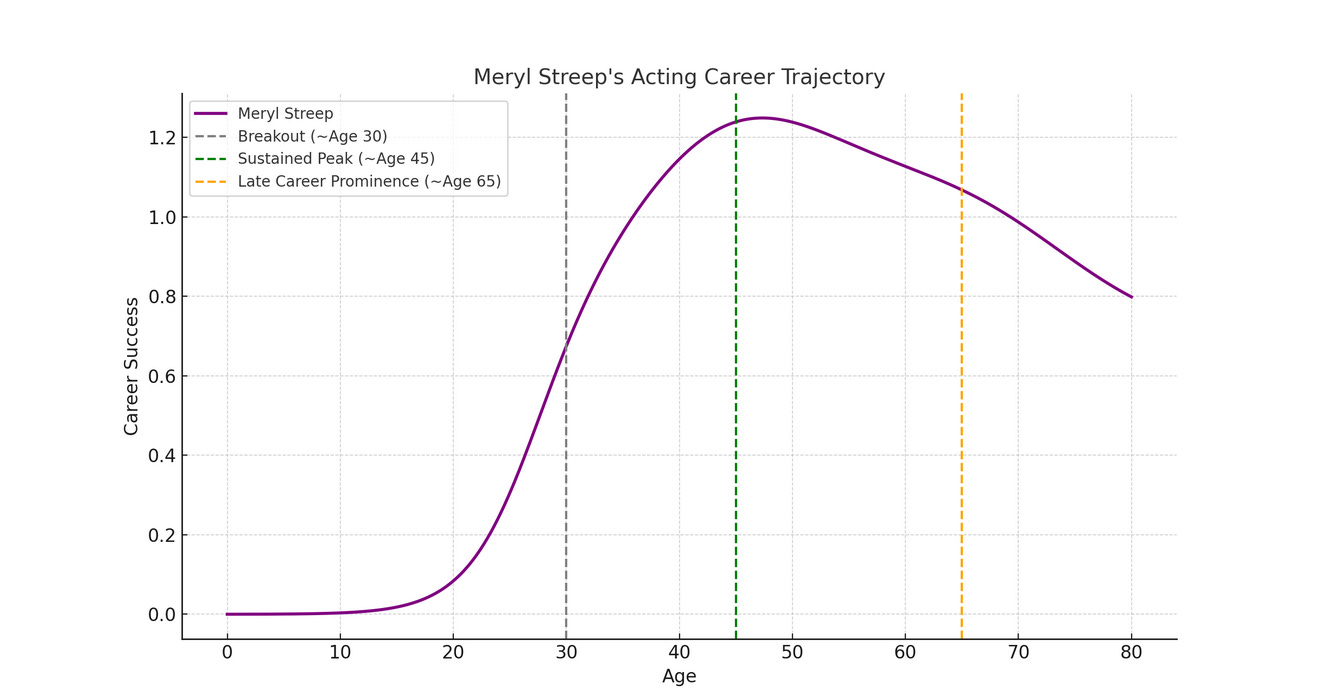
Other actors have wide peaks. Their careers hit a peak and they continue to ride the peak well into their 60s or 70s. Tom Cruise comes to mind, and so does Meryl Streep. This graph of Streep’s career arc actually undersells it. If I had to draw the graph, I’d say it shot up in her late 20s and stayed just as high ever since, with no sign it is falling.
For most actors, however, the more typical peak is some time in their 30s. I remember watching television in the 2010s and there was a period when Joel McHale, Olivia Munn, Chelsea Handler, and Zooey Deschanel were everywhere. I saw Joel McHale hosting a game show the other day, but haven’t seen the others much recently. Still other figures are late bloomers, like Julia Child, Anthony Bourdain, or Laura Ingalls Wilder, who rode late career peaks right to their deaths.
In a graph of someone’s arc of accomplishments, the area under the curve is the total amount someone has accomplished, whereas the shape of the curve is the change in accomplishment over time. You can do the same with someone’s happiness, or someone’s beauty, or physical fitness, pretty much anything we want to measure about a person’s life. Once someone’s life is complete, you can look back at the person’s entire lifespan and measure both the totality of their accomplishments as well as the arc. The totality of accomplishment, the area under the curve, tells you how rich their life was. The arc tells the story.
A question worth asking is how much the arc matters. Whose career was better once it is all over, Bryan Cranston or Woody Harrelson, who never really peaked but has had a steady list of accomplishments? From within the life timeline, these are the same questions as what we wish we had done differently, what we regret, what we’re happy with, what we value, and how we plan.
People who advocate “additive” views of value think the arc does not matter, only the area under the arc. If you are measuring someone’s life happiness, you measure the total amount of happiness, not whether it peaks or dips at various times. If you’re measuring professional success, having three platinum albums in the 90s and then disappearing until the nostalgia tour 30 years later is equivalent to having one platinum album in the 90s, one in the 2000s, and one in the 2010s, so long as everything else, like record sales, Spotify plays, and ticket sales are comparable. You compare Oasis and Weezer, to use a slightly imperfect example, and say both had equally good careers. According to Additivists, I am making a big mistake in aiming to peak in my late fifties; I should aim to maximize my accomplishments more generally, irrespective of when they happen.
“Narrativist” on the other hand believe the shape of the arc matters. The intuition is that arcs tell a story, and the quality of your life story contributes to a well-lived life. If you take Ke Huy Quan and flatten out his career arc, let’s say he was the neighbor kid on Mr. Belvedere in the 80s, was a computer nerd on some WB show in the 90s, played the annoying friend in Judd Apatow movies in the 2000s, and shows up in cameos in various streaming series today, that the totality of Quan’s accomplishments can sum up to to what the actual Ke Huy Quan has accomplished. He would have an equally good career and life according to Additivists. But according to Narrativists, that career is nowhere near as interesting as being the kid from Temple of Doom and Goonies, disappearing for 40 years, then coming out of nowhere in his 50s to win an Oscar. There is a reason comeback stories are repeatedly told for generations, while stories of persistent mediocrity are not. For Narrativists, having an interesting arc makes a life better.
Narrativists get a bad rap from philosophers these days. They point to examples of boring but otherwise virtuous lives, like a person who takes care of moderately infirm people in a kind of Sisyphean, repetitive life who has no particular accomplishment. They then dare Narrativists to claim that these people lead less good lives than people who are comparatively vicious but have interesting stories (like Breaking Bad’s Walter White).
Other counterexamples to Narrativism include lives that are not particularly good stories, like people who go from one hobby to another, but fail to turn anything into a coherent life project. People who find momentary fulfillment in fleeting interests have boring arcs. But, Additivists say, these people lead good lives, better than a lot of people who have good life stories. The obsession with good stories is just a symptom of imposing the pleasures of gossip on the value of lives.
Most of these counterexamples, in my view, overplay the hand about what makes for a good story. Stories can be interesting even if they are not particularly cinematic. Stories can be interesting episodically even if they are not particularly coherent over a lifetime. And anyway, Narrativism should be thought of as an “all things being equal” claim. Only when all else is equal does the arc make a difference to the overall quality of life. Yes, very good people who lead uninteresting lives are still much better people than very interesting people who lead very bad lives. The arc is only one thing that makes your life good.
But it can still be true that, all things being equal, with the area under the curve remaining the same, the arc of the curve contribute to the overall quality of a person’s life.
Interestingness is one amongst many things that make a life valuable. Interestingness is a value that we can graph just like we can other features of a life. My adolescent years and my 30s were far more interesting than my 20s. At 13, I got caught up in petty street crime, at 14 I developed a drug and alcohol problem, at 15-18 I alternated hair and fashion styles annually, tried my hand at House music DJing, break dancing, grunge rocking, and then swing dancing (I know, very 90s right?). But in my 20s I was pretty one dimensional, pursuing the study of humanities and then philosophy.
My 30s were far more interesting than my 20s, and my 40s even more so, in ways that I prefer not to relive (who would want to relive the 2020s?). But interestingness is not just a property of lives with their own arcs, they are properties of arcs themselves. Ke Huy Quan’s arc is more interesting that Bryan Cranston’s, even though I prefer to live Cranston’s and not Quan’s. Quan’s arc is intrinsically more interesting than even Meryl Streep’s, even though every actor, and most people really, would probably trade their accomplishments for Streep’s simply by the sheet size of the area under her arc.
To accept that arcs matter is to accept that interestingness, beauty, and other story-driven properties like redemption and tragedy make lives good. We can accept this without thereby devaluing aspects of life that are supposed to be more valuable than these story-driven aesthetic properties, like leading a morally good life. It is not a supreme value to aim for an interesting arc, but it is still a value worth having. The Ancient Greeks understood that beauty, in all of its complexity, can be a pursuit in life as much as any other virtue.
The final consideration in favor of some kind of Narrativism is that what makes for a good story isn’t just some kind of sui generis artifact of free floating values. We like comeback stories, Cinderella stories, redemption stories, and underdog stories because these are the kinds of lives from which we draw the most meaning.
Critics of Narrativism have it backwards. They think it is a mistake to impose on lives the things we value in stories. But I think we value particular story arcs because lives lived according to those arcs have a particular kind of unique value to us; they’re lives that are particularly interesting, meaningful, inspirational, worth learning from, and add both knowledge and beauty to the lives of others. It is precisely because certain life arcs have a distinctive kind of value that we think stories that have those arcs are particularly worth our attention. Interesting lives make good stories, not the other way around.
So not only do I think some kind of Narrativism is true, I think it has to be. Stories are just schemas of life arcs of particular importance to us. Peaks matter, even if I’m wrong that they ought to happen in your 50s.
I like the framework you developed for this analysis, Barry. I like the idea of accomplishments plotted over time, and the contrast between the additive view (all that matters is area under the curve) and the narrative view (the shape is important too).
I object to the move towards “all else equal” thinking though, essentially of viewing narrative as a tie-breaker. In general I don’t like this form of reasoning, because it seems like deliberately evading the most interesting issue. (This has come up recently in discussions, including on Facebook, of affirmative action too: the question of whether race and gender can serve as legitimate tie-breakers has always struck me as uninteresting and evasive.)
The most interesting issue seems to be to what extent we are or should be willing to sacrifice area for shape. I.e., are we willing to trade off some accomplishments to ensure that the shape is better, and if so how much? For example, would it ever make sense to hold back on potential easy accomplishments now, so that they instead happen later in life? E.g., I am about to publish a book which I know will be brilliant, would it ever be rational for me to think it’s too early, and I should wait and do it later? Framed that way, the desire to ensure a good shape to one’s accomplishments seems less appealing.
A related issue, illustrated beautifully by many of your examples, is that there’s a lot of luck involved, both in the overall amount of accomplishment and in its shape over time. If so, maybe even if, all else equal, the better career has a better shape, it still might be true that the best thing to do at any given moment is to accomplish as much as possible in that moment. You never know what luck you will have, so you should just always be trying to accomplish as much as possible at any given present moment, and ignore shape. If so, maybe the narrative view is, in an important sense, self-effacing. Echoing Alec Baldwin in Glengarry Glen Ross, we should follow something like ABA: Always Be Accomplishing.
On the other hand, what if the satisfaction you get from your accomplishments lessens over time? More precisely, if I accomplish something at T1, I might get a lot of satisfaction out of that at T1, but less and less as time wears on. If so, the best shape might be to spread out my accomplishments somewhat evenly, maybe a bit like how it can be rational to spread out lottery winnings into regular payments rather than one lump sum.
Anyway, this essay was provocative, and I liked the framework. It made me think through interesting issues in a new way. 👍
Loved this post Barry. Giving us middle aged folks hope 😂